Repository navigation
Wasm/ESM integration and additional start/main functions #32
Description

When starting up a Wasm module or application, it's often not enough to call the Wasm start function. Often, there's some kind of external code driving it, maybe generated by the toolchain or otherwise present in the host environment.
One idea from WebAssembly/design#1160 to reduce the need for this sort of "driver" code was to make Wasm/ESM integration call a secondary "_start" function, after the exports are initialized, to permit the driver module to have the Wasm exports before functions that it exports to Wasm are run. However, there are some cases which don't quite meet this model:
- Before calling the WASI
_startfunction, the exported memory could be passed into WASI https://github.com/nodejs/node/pull/27850/files#diff-ab9c666b48467c7030bd93aac6d06eb2R184 - For command-style programs, we may want to have a difference between running a command and using it Importing a Wasm program #30
I suspect, if we examine more systems, we'll find more kinds of mismatches or subtle cases where more behavior is needed.
The goal for this issue is to compile patterns from various Wasm toolchains and environments, and see what would make sense to standardize. This standard initialization behavior could be used both in JS and outside of JS environments, in common between the two.
I'd like to see if we can coalesce on the design of a new custom section to declaratively specify this initialization behavior. I think it will make sense to do on top of the basic Wasm module semantics, with the start function being invoked atomically with module initialization before exports are made available, as explained by @rossberg.
I think the MVP Wasm/ESM integration semantics make sense as is, and any further behavior will be a v2 that layers on top. If you disagree, I'd love to understand better why in this thread, so we can make it clear to potential implementers of Wasm/ESM integration whether this is stable.
Activity
devsnek commentedon Jun 21, 2019
Horcrux7 commentedon Jun 21, 2019
Forgive my naivety. But why can the memory not pass as anyref? Then no injection of shared memory from the host is needed.
devsnek commentedon Jun 21, 2019
@Horcrux7 from the perspective of a wasm module, if you want to import a function that has some functionality beyond what can be done with scalar values, you would need that function, the implementation, to have access to your memory to pass the data around. For example, I import a
read_filefunction from the host, how does it write the contents of the file into my memory?devsnek commentedon Jun 21, 2019
Also on the subject of the custom logic, It would be great if it was possible to call custom entrypoints during the evaluation phase. So far WASI has _start and __wasi_unstable_reactor_start, and N-API has _napi_register.
Horcrux7 commentedon Jun 21, 2019
Currently this is not possible. But in C and many other languages would you pass a pointer to the memory to put the data.
Only in Wasm you have to pass an int value with a position. And the memory is one large static shared block. Wrong code can write to any location in this memory.
littledan commentedon Jun 21, 2019
@devsnek The purpose of this issue is to find general, cross-environment solutions to the problem you are articulating. One possibly would be a "host hook" to let, say, WASI do something when the module starts up (as your integration does). I'd like to figure out which pattern we should broadly encourage.
xtuc commentedon Aug 8, 2020
What do you think about adding a new custom section that stores the index of the additional start function and how to run:
A. as a regular function, after the start function and calling into the event-loop. Fixes the bundler, esm-integration and WASI use case.
B. same as A but re-instantates the module first. Fixes the CLI program issue #30.
devsnek commentedon Aug 8, 2020
My understanding was that this would be solved by interface types providing the ability to pass nonscalar values as arguments.
xtuc commentedon Aug 8, 2020
that's true if you pass all your imports as arguments in the main function, but I doubt it will be very practical in all cases.
devsnek commentedon Aug 8, 2020
@xtuc the main function can already access the module's imports, i'm not sure what you mean.
xtuc commentedon Aug 8, 2020
by the time the main function runs the JavaScript imports aren't executed because the instantiation is in a single tick and Wasm will snapshot undefined values (apart from functions). Exporting an additional start function defers the main function's code basically
devsnek commentedon Aug 8, 2020
so the concern is about circulars which expose tdz and get snapshotted as
undefined?xtuc commentedon Aug 8, 2020
I believe it's any imports, apart functions that are initialized before
devsnek commentedon Aug 8, 2020
@xtuc if you do
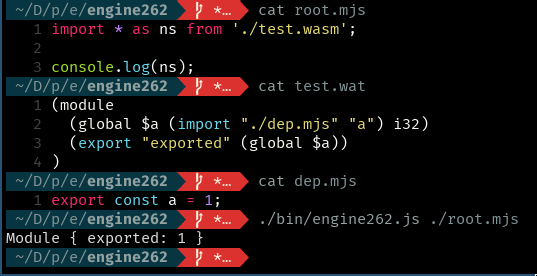
export let a = 1and then(import "whatever" "a"), it should work fine. thelet a = 1will evaluate before the execution of the wasm module (https://webassembly.github.io/esm-integration/js-api/index.html#module-execution). the case where it would not work fine is if there is a circularity between those where the wasm module's evaluation happens first, exacerbated because of the value snapshots.recreated the proposal in engine262, seems to work:
xtuc commentedon Aug 9, 2020
For scalar values you are right, we ran into issues when importing objects like WebAssembly.Memory/Table/Global
devsnek commentedon Aug 9, 2020
@xtuc so if I export a webassembly.memory from js, it gets imported in the cyclic module as that value, and then passed directly to the instantiate call via the import object. it seems like that should be sufficient?
guybedford commentedon Aug 9, 2020
Perhaps the confusion here is the async execution of Wasm resulting in these objects being initialized after a tick as @xtuc says. Note this is the reason that top-level await was a prerequisite for the Wasm integration with ES modules, and using those paths in v8 for the integration would line up with the esm integration intention I believe.
guybedford commentedon Jul 11, 2025
With the reservation of
wasm:andwasm-js:schemes in the export name, we could in theory add a newwasm:initorwasm-js:initspecifically for the ESM Integration instance phase now, while allowing the implementation to ship without hampering such a possibility.Will leave this open for further discussion if interest in that comes up in future.