Repository navigation
Incorrect type narrowing after Array.isArray typeguard on union with generic #46534
Description

Bug Report
🔎 Search Terms
- label:Bug typeguard
- label:Bug narrow* incorrect
🕗 Version & Regression Information
- This is the behavior in every version I tried, and I reviewed the FAQ for entries about "Bugs" that have existed in TS for a long time
- I tested versions:
- v3.3.33333 (playground)
- v4.4.4 (playground)
- v4.5.0-dev.202111026 (playground)
⏯ Playground Link
- v3.3.33333 (playground)
- v4.4.4 (playground)
- v4.5.0-dev.202111026 (playground)
💻 Code
function logStringAssumption(input: string) {
    console.log(`Type system is sure that typeof ${input} (aka '${typeof input}') must be 'string'`);
}
function test<I>(input: string[] | I) {
  if (Array.isArray(input)) {
      logStringAssumption(input[0]);
  }
}
test([12345]);
🙁 Actual behavior
- In line 6 of the code above (line 8 in the screenshot),
inputis inferred to be of typestring[] - Passing
input[0]intologStringAssumptioncompiles successfully
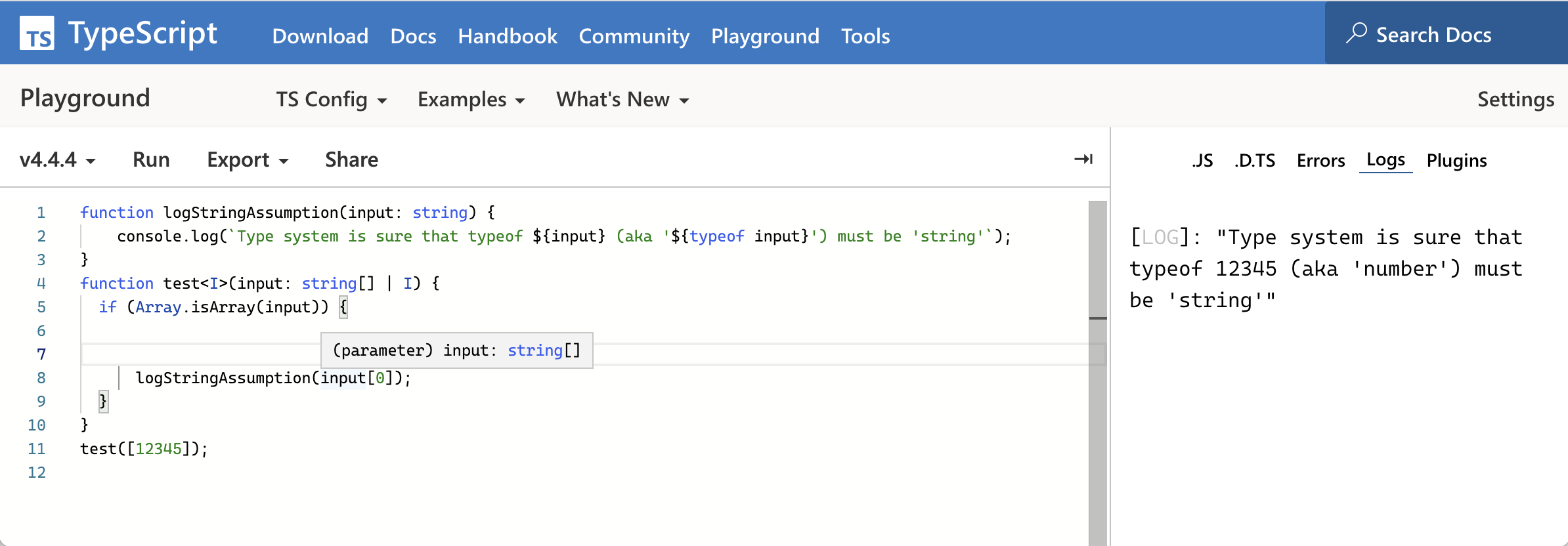
🙂 Expected behavior
- The typechecker should account for the fact, that
Ican be some other array type such asnumber[] - In line 6,
inputshould be inferred to be of typestring[] | (I & any[]) - Passing
input[0]should not compile asanyis not assignable tostring
Activity
k-tten commentedon Oct 26, 2021
You haven't defined the typeIand thus TypeScript has no reason to assume thatIis an array-like type?Ok nevermind I see the generic 😅
I don't quite agree that
inputshould be inferred asstring[] | (I & any[])thoI see where you're coming from, but I think this problem arises from design: why would a function accept
string[]or any type (the generic)fatcerberus commentedon Oct 26, 2021
Usually for a same reason you might write:
We don’t have negated types, so the closest you can get for now is taking the union of a generic with a concrete type and letting type inference exclude the concrete case.
k-tten commentedon Oct 26, 2021
Eh I don't see the similarity in your example and theirs. Would you mind sharing another example? 🥲
I see some similarities but I think the type guard and
null | undefinedmakes it a tad different.fatcerberus commentedon Oct 26, 2021
The idea is the same - by accepting
string[] | Ias a parameter, the type inference machinery ensuresIisn't instantiated withstring[]. It's not perfect (you can instantiate the generic manually, e.g.), but it's the closest we can get without negated types.andrewbranch commentedon Nov 4, 2021
Duplicate of #45686
typescript-bot commentedon Nov 7, 2021
This issue has been marked as a 'Duplicate' and has seen no recent activity. It has been automatically closed for house-keeping purposes.